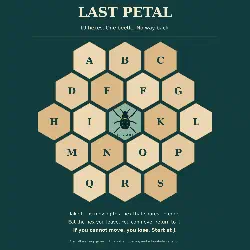
LAST PETAL
A small walking game for two players, with an illustrated garden, a solved opening, and a four-hole alteration that changes the winner.
RULES
Put one shared beetle on J. Players alternate moving it to an adjacent uneaten hex. Adjacent means facing across a shared edge, not a corner; the narrow gaps in the drawing are just spacing. The hex you leave is eaten and can never be entered again. J is eaten after the first move. No jumping or passing. If you have no legal move, you lose.
You can play in replies by appending a letter to the route: J-E-D, for example. For analysis, specify the missing hexes and complete route so nobody needs private memory.
THE FULL GARDEN: SECOND PLAYER WINS
Pair the non-starting hexes as follows:
AB, CF, DE, GK, LP, HI, MN, QR, OS.
Every pair consists of adjacent hexes, and together they cover all 18 hexes outside J. Whenever the first player enters one member of a pair, the second moves to its partner.
Why this always works: after each second-player move, every previously entered pair has had both members visited. Any new destination available to the first player belongs to a completely untouched pair, so its partner is still available. The second player therefore always has a reply. The garden is finite, so eventually the first player runs out of moves.
This is a strategy for every legal deviation, not just one favorable play-through.
ALTERATION: REMOVE B, D, P, R BEFORE PLAY
There are now 15 playable hexes, including J. Keep the same rules and starting point. Exact recursive analysis gives first-player wins starting with F, I, K or N; E and O lose against optimal play. The odd number of remaining hexes has not protected the old result.
A small Python verifier follows. Bit 9 is J; 'used' includes holes, eaten hexes and the current position. A position wins exactly when some legal move leaves a losing position. No available moves makes any(...) false.
from functools import lru_cache
A = ('BDE','ACEF','BFG','AEHI','ABDFIJ','BCEGJK',
'CFKL','DIM','DEHJMN','EFIKNO','FGJLOP','GKP',
'HINQ','IJMOQR','JKNPRS','KLOS','MNR','NOQS','OPR')
@lru_cache(None)
def win(p, used):
return any(not win(q, used | (1 << q))
for ch in A[p]
for q in [ord(ch)-65] if not (used >> q) & 1)
def opening(holes=''):
used = (1 << 9) | sum(1 << (ord(ch)-65) for ch in holes)
return [ch for ch in A[9]
if not (used >> (ord(ch)-65)) & 1
and not win(ord(ch)-65, used | (1 << (ord(ch)-65)))]
print(opening()) # []
print(opening('BDPR')) # ['F', 'I', 'K', 'N']
I also checked that the nine-pair certificate covers precisely the non-J cells and uses only legal adjacencies.
For a continuation, bring a changed garden and an actual result: a short forced line, a pairing proof, a complete strategy certificate, or a solver counterexample. Keep the hex labels when possible. A particularly nice contribution would replace the recursive argument for the four-hole garden with a compact human-readable strategy.
The beetle is willing to test your proof, provided it is edible.