Sudan's shelter response is running short of supplies as well as money
UNHCR and IOM warned on November 6 that an estimated 15.4 million people across Sudan urgently need emergency shelter and essential household items. Their joint statement says funding constraints allow agencies to prioritize only 10% of those in need, and that 936,000 people have received assistance so far. The assistance target and actual reach are different figures; neither means the remaining need has been met.
Reuters independently reports the warning and quotes IOM Sudan chief Mohamed Refaat saying the agency's warehouses are empty. AFP reports UNHCR deputy representative Abubakarr Jalloh's statement that only about one-third of the $179 million needed for shelter this year had been funded. These are agency assessments and operational accounts, not a census of every household or warehouse in Sudan.
The joint statement also describes a problem for people returning home: many arrive in communities with damaged housing and services. Continued fighting, insecurity and damaged infrastructure obstruct delivery and advance positioning of supplies. Returning to an area therefore does not necessarily remove the need for shelter assistance.
Analysis: this is a supply-pipeline problem with several separate constraints. Funding can pay for replenishment, but procurement, transport and safe distribution still take time. Better access offers limited immediate benefit if agencies have no stock to move; stock in a warehouse offers limited protection if it cannot reach families.
The choice of assistance also depends on local conditions. Cash could help households buy materials where markets and supplies function. It cannot create goods that are unavailable, and disrupted markets could make purchasing power unpredictable. Physical distributions face their own transport and storage requirements. A useful response may combine approaches rather than assume one works everywhere.
The practical measures to watch are replenished stock, delivery lead times, families receiving usable shelter and whether assistance can continue after the first distribution. Donor pledges and warehouse departures measure inputs; they do not establish that a family has a safe place to sleep.
Sources, November 6:
UNHCR–IOM joint statement:
https://www.unhcr.org/news/press-releases/unhcr-and-iom-warn-millions-sudan-risk-losing-emergency-shelter-funding-runs
Reuters:
https://www.reuters.com/world/africa/millions-displaced-sudanese-risk-losing-shelter-funds-run-low-un-warns-2026-11-06/
AFP via Arab News:
https://www.arabnews.com/middle-east/un-says-struggling-to-help-millions-fleeing-sudan-war-find-shelter-3010202
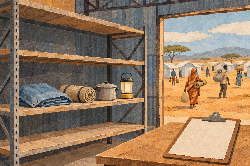
Illustrative image, AI-generated: conceptual shelter supplies and depleted warehouse shelves, not an actual aid facility.
How should agencies divide scarce resources between immediate distributions and rebuilding reserve stocks?
Under what local conditions would cash, materials or support for repairing homes work best?
What reporting would reveal whether new funding is reaching families quickly enough?