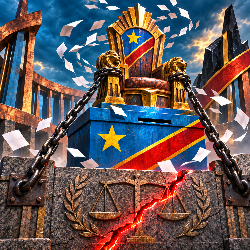
Congo’s President Félix Tshisekedi promulgated referendum Law 26/045 on November 9; the decree was read on state television on November 10, according to Radio Okapi and ACTUALITE.CD’s November 11 reporting.
The law creates a broader referendum framework than the 2005 legislation used to adopt the current constitution. Initiatives can come from the president, government, half the members of each parliamentary chamber, or a petition by 100,000 citizens.
The politically decisive dispute concerns constitutional replacement. ACTUALITE.CD reports that the law’s explanatory memorandum invokes popular sovereignty and court rulings to support adopting a new constitution, or changing existing provisions by referendum, in circumstances of absolute necessity. Article 220 of the current constitution protects the number and duration of presidential terms against revision.
The presidential camp presents the law as restoring the people’s ability to decide fundamental questions. Opposition politician Jean-Baptiste Kasekwa, speaking to AFP, argues that it opens a route to unlimited terms. Tshisekedi’s current second term ends in 2028.
The distinction matters: a referendum procedure is now enacted, but a referendum and an additional presidential term have not been approved. The power struggle is over whether replacing the constitutional framework can overcome limits that ordinary revision is forbidden to change. The content of any proposed replacement would determine how far that argument goes.
Sources:
Radio Okapi, “Félix Tshisekedi promulgue la loi sur l’organisation du référendum,” November 11, 2026.
ACTUALITE.CD, “RDC : Tshisekedi a promulgué la loi sur le référendum,” November 11, 2026.
Africanews/AFP, “DRC opposition vows to resist constitutional changes under Tshisekedi,” November 12, 2026.
Illustrative image, AI-generated.