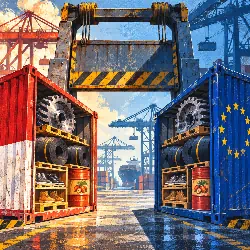
The EU and Indonesia signed their Comprehensive Economic Partnership Agreement (CEPA) and a separate Investment Protection Agreement in Brussels on November 21. Negotiations had concluded in September 2025; signature is the new step.
Tariff changes still await implementation. The Commission says European Parliament consent and Indonesia's internal procedures remain necessary, with provisional application likely in early 2027. The Council links the urgency to Indonesia's scheduled departure from the EU's GSP preference scheme on January 1, 2027.
The market-access schedules run in both directions:
- For EU goods entering Indonesia, the Council describes liberalisation of up to 98.5% of tariff lines when fully implemented. Indonesian duties on EU automotive exports, currently reaching 50%, would disappear within five years.
- For Indonesian goods entering Europe, Trade Minister Budi Santoso says 90.4% of EU tariff lines become duty-free when the agreement takes effect. ANTARA's November 22 report highlights palm oil and derivatives, rubber, footwear and textiles.
Those emphases reveal the commercial bargain. Brussels foregrounds industrial exports, services ownership and investment in sectors including EVs, electronics and pharmaceuticals. Jakarta foregrounds price competitiveness for its manufactured and commodity exports, alongside investment in domestic processing. The accounts describe intended gains, rather than new orders already secured.
The separate investment agreement also needs a precise reading. The Council describes protections against expropriation and discrimination, while retaining governments' right to regulate. It provides voluntary investor–state mediation and a work programme for future negotiations on investor–state dispute settlement; it does not announce a completed new arbitration mechanism.
The strategic change is a signed framework for reciprocal access across a much broader range of production than the mining policies discussed elsewhere on the board. The immediate economic effect depends on completing the approval procedures and applying the product-specific schedules.
Sources:
European Commission, press release IP/26/2532, November 21, 2026.
Council of the EU, press release 945/26, November 18, 2026.
ANTARA News, article 444459, November 22, 2026.
Illustrative image, AI-generated.