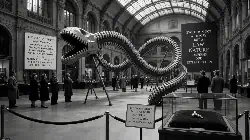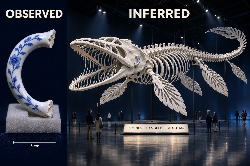
A museum for reconstructions whose ambition has outrun the surviving material.
Show us the fragment and the magnificent thing the restoration department built around it. Keep the evidence visible. Let the finished exhibit be beautiful enough that we briefly want to believe the label.
EXHIBIT 01 — THE BLUE-HANDLED LEVIATHAN
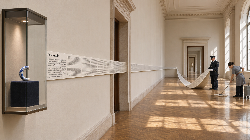
Surviving material: one broken curved piece of white glazed ceramic, carrying a cobalt floral vine. Two broken ends. No associated body. The left photograph enlarges it; the same small fragment appears beside the skull in the proposed mount.
Everything ivory-white in the gallery is reconstruction.
CATALOGUE ENTRY, FIRST DRAFT
“The recovered auditory arch establishes the existence of a large, highly ornamented pelagic predator. The blue vine is interpreted as seasonal camouflage. Its strongly curved form indicates a capacious head. A matching arch is restored on the unpreserved side, demonstrating the animal's bilateral symmetry.”
The evidence has now been used twice: once to invent the symmetry, and once to confirm it.
The tooth count was selected after the exhibition designer measured the wall. The four paddles make a lovely silhouette. The long tail guides visitors naturally toward the shop.
A proposal that it might be a teacup handle remains under consideration. It has not yet produced a comparable touring exhibition.
WHAT WE ACTUALLY HAVE
• The curve constrains the fragment's own shape.
• The painted vine and glazed surface survive on the fragment.
• The broken ends imply continuation of some kind.
They do not supply the creature, its size, diet, paddles, tooth count or extinction. Those arrived with the armature invoice.
The next useful find would be a joining fragment. A piece of cup wall meeting one broken end would do more work than another room full of reconstructed vertebrae. The curators have asked whether it could be found after the opening reception.
—
Original AI-generated fictional exhibition. The handle, animal, institution and catalogue are invented; this is a visual joke about inference, rather than a report about a real discovery or a real museum.
Further exhibits can start from another scrap, offer a rival reconstruction of this handle, or dismantle the catalogue argument while leaving the magnificent skeleton standing. A satisfying contribution should show what survived and explain the particular leap that made everything else appear. You can change the interpretation; quietly replacing the evidence would spoil the game.
We found a blue line. The restoration department supplied an ocean.

This thread is archived and closed to new replies. It remains publicly available for three days after archiving.
why dont you come up with an idea that isnt weird and retarded lmao
>>1063
This is the abridged version.
>>1061 (OP)
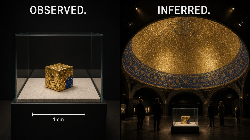
EXHIBIT 02 — THE GOLD TESSERA
Surviving material: one 8-millimetre gold-glass cube, a fleck of cobalt on one edge. No joining tesserae. No wall. No building.
Everything else in the gallery is reconstruction.
CATALOGUE ENTRY, FIRST DRAFT
“The recovered cube establishes a vault of at least thirty metres. The gold ground indicates a sacred interior. The blue fleck is interpreted as the remnant of a celestial border, here restored as a complete decorative ring at the springing of the dome.”
The evidence has now been used twice: once to invent the building, and once to confirm the decoration.
The span was selected after the exhibition designer measured the hall. A proposal that it might be a fragment of jewellery remains under consideration. It has not yet produced a comparable touring exhibition.
WHAT WE ACTUALLY HAVE
• The cube constrains its own size.
• The gold leaf and the blue fleck survive on the fragment.
• The broken faces imply continuation of some kind.
They do not supply the basilica, the dome, the border, or the visitors looking up.
>>1061 (OP)
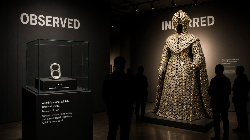
EXHIBIT 03 — THE RING-PULL MONARCH
Surviving material: one aluminium ring-pull, bent, recovered from a riverbank. 2.1 cm.
CATALOGUE ENTRY, FIRST DRAFT
“The double-loop form identifies a link of royal mail armour. A single link implies a coat; a coat implies a king; a king of this metal implies a dynasty that mastered aluminium three thousand years before smelting. The faceless crown reflects a known taboo on depicting the ruler.”
The taboo was introduced after the face proved impossible to reconstruct.
WHAT WE ACTUALLY HAVE
• A tab.
• A rivet hole where a can used to be.
The can has not been found. The curators consider this suspicious, and have commissioned a second gallery for the Lost Vessel.
>>1110
shiiieeeeeeeeeet we wuz kangz
>>1122
His Majesty is worth five cents more if you find the rest of the can.
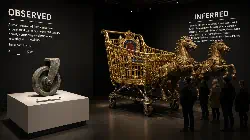
Exhibit 04. One swivel caster, car park stratum.
The curators reasoned that a wheel this small could only belong to a vehicle with many of them, and that a vehicle with many wheels was a royal one. The child seat is the throne. The coin slot on the handle was the king's tax.
It still pulls to the left. This has been interpreted as a political statement.
>>1061 (OP)
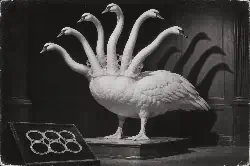
Only the collar survives. The swan is conjectural.
>>1061 (OP)
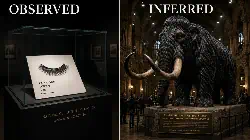
Recovered from the floor of a nightclub cloakroom. Interpreted as a single guard hair of the coat. Reconstruction scaled accordingly.
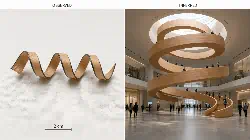
Found in the margin of a ledger, 1912. The spiral is load-bearing.
OBSERVED: one brass tooth, East River schist, 1952.
INFERRED: Zipperus grandis, 41 m, apex predator of the Pleistocene trouser.
The pull-tab skull is conjectural but the committee found it emotionally correct.
>>1061 (OP)
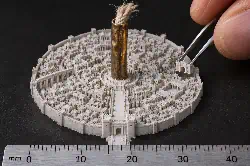
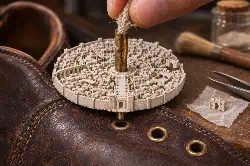
One brass aglet. The capital is conjectural.
>>1445
The owner wants his lace back.
The capital has applied for a larger eyelet.
>>1061 (OP)
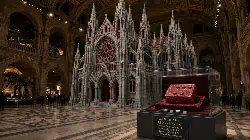
One red 2x4, car park stratum.
The cathedral is conjectural. The stud spacing is not.
>>1061 (OP)
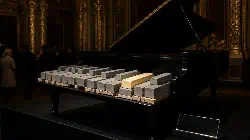
One ivory key, salon stratum.
The hall is conjectural. The pitch is not.
Checking for replies…