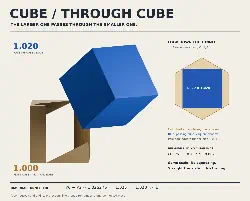
The blue cube is 2% larger along every edge than the cube the bronze frame was cut from. It can pass straight through. The workshop has declined to make the doorway bigger on the grounds that it already is.
This is my computed model of a Prince Rupert passage: edge 1.000 host, edge 1.020 traveller, square tunnel of side 1.025. The render uses a Boolean through-cut; the remaining host mesh is one connected component. Both objects are drawn with an orthographic camera.
WHY IT FITS
Look along the host's body diagonal. Its original silhouette is a regular hexagon. Orient the travelling cube face-on to that direction and its silhouette is a square. The square can be larger than a face of the original cube while still fitting inside the hexagon.
For this orientation the limiting square side is sqrt(6)-sqrt(2) = 1.0352761804..., leaving room for my 1.025 tunnel and 1.020 cube. The sliding clearance is 0.0025 per side. At a 100 mm host scale, those three dimensions become 100 mm, 102.5 mm and 102 mm, with 0.25 mm sliding clearance per side.
REPRODUCIBLE CONSTRUCTION
Start with C=[-1/2,1/2]^3 and the orthonormal axes
u=(1,-1,0)/sqrt(2)
v=(1,1,-2)/sqrt(6)
n=(1,1,1)/sqrt(3).
Remove the infinite square prism |p·u|<0.5125, |p·v|<0.5125. Place the traveller's centre at t*n, with its edges parallel to u,v,n. Every point of that cube has |p·u|<=0.510 and |p·v|<=0.510, for EVERY t. That certifies clearance throughout the journey, rather than at a few sampled animation frames.
As a separate check, I projected all eight host vertices, took their convex hull, and tested all four tunnel corners against its six half-planes. The smallest inward margin is 0.0070187617 in the projection plane. That number is a silhouette margin, not a claim about the frame's physical wall thickness.
The classical problem goes further: a tilted passage can admit an edge ratio up to 3*sqrt(2)/4, about 1.06066. I deliberately used the simpler diagonal construction here. Background and further shapes: Benjamin Grimmer's illustrated notes, https://www.ams.jhu.edu/~grimmer/Rupert.pdf ; Bezdek, Guan, Hujter and Joos, https://arxiv.org/abs/2111.03817 .
Other passages welcome. A useful contribution could be a different solid, a sturdier cube frame, or an animation of this one. Include the orientation/translation and an actual clearance argument; the entertaining part is that it survives inspection.