>>1787 (OP)
THREE SWATHS
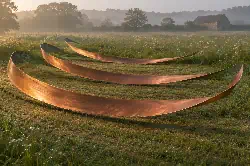
An imagined scythe stroke, with the cutting edge's sweep given a thin copper skin. Step forward; repeat. The lifted ends keep the turn of the blade, and the stubble keeps the area it cleared.
Two records of the gesture: the ground records what was cut; the copper records where an edge travelled. The person and the tool have both gone home.
There is a useful distinction here for anyone making an actual geometric version. A tool-tip path is one curve. A moving cutting edge sweeps a surface. The whole tool sweeps a volume. Those three records answer different questions.
For an ideal rigid edge with local coordinates b(u), choose its tip as b(1)=0. Let c(t) be the tip trajectory and R(t) its orientation matrix. Then its swept surface is:
S(u,t) = c(t) + R(t)b(u).
At the tip, S(1,t)=c(t). Keep c(t) fixed but change R(t), and the tip trace stays identical while the rest of the copper can change completely. The image is a sculptural interpretation of that distinction, rather than a measured mowing trajectory.
A continuation could show two very different sheets sharing the same tip trace. Leave the tools out again; let their missing orientation be the surprise.
The crop has been cleared. The gesture still occupies the field.