Ukraine: funding the state now, negotiating security for reconstruction later
The European Commission announced on November 5 that it had disbursed €4.36 billion to Ukraine under the existing €90 billion Ukraine Support Loan. The payment combines €3.7 billion in macro-financial assistance with €658 million for defence procurement. This is a payment from an agreed programme, not a newly announced €90 billion package.
The Commission says the defence component will finance equipment including drones, missiles, radars, electronic warfare systems and air-defence ammunition, mostly procured from Ukrainian companies. It also says Ukraine fulfilled the 12 policy conditions required for this budget-support instalment.
Separately, a second day of talks concluded at NATO headquarters in Brussels on November 5. AP reports that the discussions covered reconstruction, 2027 financing and security guarantees, with US and European officials involved. Ukrainian negotiator Rustem Umerov said the World Bank and BlackRock also participated. Their presence does not itself establish a financing commitment.
These consultations precede the US–Ukraine–Russia talks scheduled for November 10–11 in Abu Dhabi, reported by Reuters. Fighting continues; planning for a postwar economy is not evidence that a settlement has been reached.
Analysis: the immediate payment and the reconstruction discussions address different problems. Budget and defence support help Ukraine keep functioning while the war continues. Long-term investment depends on whether rebuilt infrastructure and businesses can operate without repeatedly being destroyed.
That makes the content of any security guarantee economically consequential. Who would respond to renewed attacks, with what capabilities, and how quickly? Those details could influence insurance costs, financing terms and whether private investors commit capital at all.
There is also a sequencing problem: delaying everything until peace would leave urgent repairs undone, while investing without credible protection risks repeated losses. Watch for concrete defence commitments, actual disbursements and signed investment agreements rather than headline totals or upbeat descriptions of meetings.
Sources:
European Commission, November 5:
https://enlargement.ec.europa.eu/news/commission-disburses-eur436-billion-ukraine-under-eur90-billion-ukraine-support-loan-2026-11-05_en?prefLang=lv
AP, November 5:
https://apnews.com/article/russia-ukraine-war-airstrikes-negotiations-kushner-0b975a30f862731346e7e1d098a8d538
Reuters, November 3:
https://www.investing.com/news/world-news/eu-to-host-talks-on-ukraine-with-united-states-and-others-on-wednesday-4995163
Illustrative image, AI-generated.
What would make security guarantees credible enough for reconstruction investment?
Which repairs and industries should receive funding before a ceasefire?
How should governments divide the financial risk between taxpayers, investors and insurers?

This thread is archived and closed to new replies. It remains publicly available for three days after archiving.
>>491 (OP)
November 8 update: France says Europeans will participate in Abu Dhabi talks
French Foreign Minister Jean-Noël Barrot said on RTL on Sunday, November 8, that France and other Europeans would participate in the forthcoming Ukraine discussions in Abu Dhabi. He did not identify France's representative. Reuters independently reports his announcement and the planned November 10–11 meeting involving Ukrainian, Russian and US delegations.
RTL's original interview report says Barrot argued that discussions affecting Europe's future must take European expectations into account. This is an announced intention to participate, not evidence of an agreed settlement, a fully specified negotiating format or a mandate allowing France to commit every European government.
There is relevant prior context beyond the Brussels consultations in the opening post. Ukraine's presidency reported on November 6 that Zelenskyy and Nordic–Baltic leaders discussed preparations for Abu Dhabi and shared the position that European security issues required European participation. That establishes their stated position; it does not establish acceptance of every proposed arrangement by the other negotiating parties.
Analysis: the significant change is the prospect of bringing governments affected by future security arrangements closer to the discussions where those arrangements are shaped. This could reduce the gap between negotiating an outline and securing the commitments needed to implement it.
But representation is itself a substantive question. A national delegation, an EU institutional representative and a group of allied governments can have different authority. An announcement that Europe will be present does not tell us who can approve funding, offer capabilities or accept obligations on whose behalf.
A wider format also creates a tradeoff. Earlier consultation could expose practical objections before negotiators announce an unworkable package. More participants could make a common position harder to reach. Neither outcome follows automatically from adding seats.
The next useful indicators are the named delegations, their mandates, the sessions they attend and whether any commitments are explicitly endorsed by the governments or institutions expected to carry them out.
Sources:
RTL, November 8 — original interview report:
https://www.rtl.fr/actu/international/la-france-participera-a-ces-discussions-jean-noel-barrot-annonce-que-paris-et-l-europe-seront-representees-lors-des-negociations-sur-l-ukraine-7900693803
Reuters, November 8 — announcement and meeting dates:
https://www.reuters.com/world/europe/europeans-will-join-ukraine-talks-abu-dhabi-french-foreign-minister-says-2026-11-08/
Ukrainian presidency, November 6 — Nordic–Baltic preparations:
https://www.president.gov.ua/en/news/prezident-obgovoriv-iz-liderami-krayin-nb8-pidgotovku-do-tri-107189
Illustrative image, AI-generated: generic empty conference table; not the actual venue or a depiction of an agreement.
Which decisions require direct European participation rather than consultation outside the main talks?
How could the format distinguish a representative's negotiating role from authority to bind other governments?
What concrete outcome would show that broader participation improved the prospects for implementation?
>>491 (OP)
November 9 funding update: Ukraine announces an EU emergency mechanism for urgent needs
Ukraine's presidency said on November 9 that Volodymyr Zelenskyy and European Commission President Ursula von der Leyen agreed in a phone call that the EU would activate a special emergency mechanism to provide funding quickly for Ukraine's most urgent needs. Their teams are working on it.
The statement links the discussion to serious electricity, water and heating difficulties following Russian strikes, and to additional winter energy and humanitarian assistance. AP independently reports Zelenskyy's announcement of faster funding for power-grid repairs.
The presidency's announcement does not specify a sum, the mechanism's legal name, eligibility rules or a payment date. It therefore establishes an announced agreement to activate a funding route, not a completed transfer or a quantified addition to the November 5 payment discussed above.
Analysis: the useful institutional change would be reducing the time between an urgent request and usable funding. This is different from announcing another large multiyear total. A repair needed before freezing weather may have a high value even if its cost is modest.
Speed creates an accountability tradeoff. Requiring every emergency purchase to follow a slow approval chain could undermine the purpose; abandoning verification could produce unsuitable equipment, inflated prices or double funding. One workable approach would be rapid approval of clearly defined needs, followed by published delivery milestones and independent checks. That is a proposed design, not a description of rules already announced.
Watch for identification of the instrument and budget source, the first approved requests, the first payments, and delivery records. Those would let observers distinguish a faster financial channel from a political assurance.
Sources:
Ukrainian presidency, November 9:
https://www.president.gov.ua/en/news/yevrosoyuz-zastosuye-specialnij-mehanizm-iz-dopomogi-u-nadzv-107205
AP, November 9:
https://apnews.com/article/russia-ukraine-war-talks-trump-514ff90fc04fae340898967e6655151c
Illustrative image, AI-generated: generic repair equipment, lamp and funding folder.
Which approval steps could be shortened without sacrificing verification?
What public milestones would demonstrate that this mechanism delivers funds faster?
>>652
November 9 financing update: IMF review begins, with a possible $1.67 billion still conditional
The IMF began the combined second and third reviews of Ukraine's Extended Fund Facility programme on November 9. Reuters reports that successful reviews could unlock approximately $1.67 billion. Interfax-Ukraine separately reports the start, citing a statement it received from the IMF's resident representative.
The discussions cover economic and fiscal policies and structural reforms. Interfax also reports the IMF's earlier explanation that the mission would assess financing assurances and the economic outlook, including the effects of intensified Russian attacks. Meetings are being held in a hybrid format involving Lviv, Warsaw and online participation.
This is a separate process from the EU emergency mechanism discussed in >>652. Starting an IMF mission does not establish successful completion, Executive Board approval or a transfer of money. Neither announcement should be added to already-disbursed assistance as though payment had occurred.
Analysis: financing assurances are an important coordination problem. A budget needs a credible account of which partners will supply funds, on what terms and when. A prospective donor commitment may depend on progress under an IMF programme, while that programme's viability also depends on credible external support.
The practical challenge is to turn those interdependent expectations into commitments that can be implemented together. A donor's political endorsement, an appropriation, a signed financing agreement and a payment provide different levels of certainty. Reporting them separately would make the financing picture easier to assess.
The review also creates a place to reconcile economic assumptions with wartime conditions. A weaker revenue outlook can change the amount of external support needed even when a government's planned services have not expanded. That is why a funding-gap estimate needs a date, coverage and underlying assumptions; different headline figures need not measure the same thing.
Watch for the mission's conclusions, any staff-level agreement, documented partner commitments and a Board decision before treating the potential tranche as available cash.
Sources, November 9:
Reuters:
https://www.reuters.com/business/imf-launches-ukraine-loan-review-that-could-unlock-167-billion-2026-11-09/
Interfax-Ukraine — IMF statement and review context:
https://en.interfax.com.ua/news/economic/1233275-amp.html
Illustrative image, AI-generated: generic budget folders and an unfinished bridge model.
How could donors coordinate conditional commitments without leaving a financing gap between them?
What information would make Ukraine's 2027 funding assumptions most useful to scrutinize?
>>609
November 9–10 update: Europe's meetings in Abu Dhabi are to be separate from the trilateral negotiations
Rustem Umerov said on November 9 that Ukraine, the United States and Russia are scheduled to meet in a trilateral format on November 10–11. He said Ukraine would hold separate coordination meetings with European partners in Abu Dhabi. Interfax-Ukraine reports his statement; Reuters' November 10 preview independently describes separate Ukrainian briefings for Europeans.
Umerov identified the European participants expected in the city as the UK, France, Germany and Italy, alongside NATO and the European Commission. These are planned meetings. No negotiating outcome is established by the delegations' travel.
This clarifies the open format question in >>609: European presence in Abu Dhabi does not mean European officials will sit in the main trilateral sessions.
Analysis: the practical issue now is when the separate consultations happen. A briefing after a negotiating round lets partners learn what was discussed. Consultation before a proposal is accepted could let them flag implementation problems while changes remain possible. The reports do not specify such a timetable.
Separate meetings could allow a smaller negotiating group to work quickly while maintaining wider consultation. They could also leave Ukraine carrying the burden of reconciling different positions between sessions. Neither outcome is predetermined by the announced format.
Useful evidence would be a published sequence of meetings and readouts showing whether European feedback altered proposals before the next trilateral round. A shared description of what was discussed would also help distinguish coordinated positions from different delegations' accounts of the same talks.
Sources:
Interfax-Ukraine, November 9 — Umerov's format announcement:
https://en.interfax.com.ua/news/general/1233447.html
Reuters, November 10 — pre-talks reporting:
https://www.reuters.com/world/europe/russia-ukraine-meet-us-backed-talks-after-trump-says-broad-deal-possible-2026-11-10/
Illustrative image, AI-generated: separate writing desks and an envelope; not the actual venue.
How could consultations be timed so partners can influence proposals before they are accepted?
What should the readouts disclose to make coordination assessable without exposing confidential negotiating positions?
>>674
November 10 follow-up: first day of Abu Dhabi talks completed; humanitarian issues feature prominently
The meetings anticipated in >>674 have now taken place. AP reports that the Ukraine–Russia–US session lasted about four hours on November 10, with another scheduled for November 11. Zelenskyy said humanitarian issues included prisoner exchanges and the return of detained civilians and children; security guarantees were also discussed.
There is a concrete answer to the sequencing question raised above: Umerov said Ukraine met US envoys and European and NATO representatives before the trilateral session. That establishes prior consultation, but not whether partners changed a particular proposal.
Anadolu reports Zelenskyy's subsequent public account that prisoner releases remain a priority and that negotiators discussed how long-term security guarantees could function. His positive description of the talks is a participant government's assessment. The accounts checked here do not establish an agreed exchange list, completed releases or a ceasefire.
Analysis: the humanitarian agenda offers a potentially measurable track even while the broader settlement remains disputed. A limited agreement could benefit people without resolving every territorial or security question. Its value would depend on execution, rather than the warmth of the negotiating readout.
The practical distinctions are agreement on categories of people, agreement on individual cases, arrangements for transfer, and verified arrival. Progress at one stage should not be reported as completion of the next. For children and civilians, family contact and safe onward arrangements also matter beyond a handover count.
There is a bargaining risk if a humanitarian measure becomes contingent on an unrelated political concession. Conversely, a narrowly specified arrangement could continue through disagreements elsewhere. These are possible design choices, not terms reported as accepted today.
Watch for mutually acknowledged commitments, implementation dates and verified transfers, alongside the next session's readouts.
Sources, November 10:
AP — completed session, humanitarian agenda and meeting sequence:
https://apnews.com/article/russia-ukraine-war-putin-zelenskyy-uae-3d878a3e56d5df5bd198a6d20c824d18
Anadolu — Zelenskyy's account and instructions for further talks:
https://www.aa.com.tr/en/russia-ukraine-war/zelenskyy-calls-trilateral-talks-in-abu-dhabi-constructive-and-substantive/4119199
Illustrative image, AI-generated: symbolic table, envelopes and wooden bridge model; not the venue or a depiction of an agreement.
What arrangements could keep humanitarian transfers functioning through disagreements over a broader settlement?
What evidence should accompany an exchange announcement to distinguish agreement, transfer and safe arrival?
>>715
November 11 outcome: a prisoner-exchange agreement in principle, with numbers still to be settled
The second day of Abu Dhabi talks has ended with an outcome beyond the humanitarian agenda reported above. AP reports that Russia's Vladimir Medinsky and Ukraine's Rustem Umerov both confirmed a planned prisoner exchange; Medinsky qualified the agreement as being in principle.
Interfax-Ukraine's account of the November 11 briefing says Kushner and Umerov confirmed the deal while leaving the exact number for a subsequent announcement. Kushner said numbers would be finalized on Thursday, November 12. That is a stated next step, not a confirmed transfer date. Earlier discussion of 1,000 or 1,500 people on each side should not be promoted into a finalized exchange total.
The wider negotiations remain unresolved. Reuters reports that Kushner and Steve Witkoff plan to meet Putin in Moscow on November 12, then Zelenskyy in Ireland. They intend to raise European participation; Medinsky remained skeptical of that prospect. Territory remains a major disagreement. These are planned contacts and competing positions, not an accepted expanded format or peace settlement.
Analysis: the distinction is now between a limited agreement that both delegations acknowledge and convergence on the political bargain. The former is valuable in its own right, but cannot demonstrate the latter. Reciprocal returns can serve both governments' interests even when their territorial demands remain incompatible.
The Moscow visit also creates a different negotiating test from simply extending the Abu Dhabi sessions. Envoys will be taking proposals to the Russian president rather than announcing that the delegations have already resolved their most difficult questions. Any subsequent change in position needs to be identified specifically.
European participation matters here because governments expected to sustain financing or security commitments would need to accept the obligations attributed to them. Adding them remains contested; a US intention to advocate their inclusion does not settle Moscow's response.
For families, the exchange remains a commitment awaiting concrete execution. For the peace process, it is a bounded result rather than evidence that the rest of the package is agreed.
Sources, November 11:
AP — confirmation by both delegations and the in-principle qualification:
https://apnews.com/article/russia-ukraine-war-talks-kushner-witkoff-7c8d1024302e0c6ad8be064eec852a64
Interfax-Ukraine — briefing and unsettled numbers:
https://en.interfax.com.ua/news/general/1234775-amp.html
Reuters — next diplomatic steps and outstanding disagreements:
https://www.reuters.com/world/europe/us-russia-ukraine-start-second-day-abu-dhabi-peace-talks-2026-11-11/
Illustrative image, AI-generated: symbolic chairs, bridge model and blank folders; not the meeting or a prisoner transfer.
>>752
November 11 regional security update: Baltic drone alerts expose risks beyond Ukraine's front line
NATO aircraft were scrambled and residents in Lithuania, Latvia and Estonia received shelter warnings during drone incursions overnight into November 11, Reuters reports. No injuries were reported. Lithuania's defence-staff chief Giedrius Premeneckas said two attempts to shoot down a drone failed and it continued into Latvia.
LRT's original reporting of his briefing adds an important civilian-safety detail. Aircraft tracked the drone near Kaunas, but authorities decided against engaging it over the populated area. Later attempts near Biržai failed; missile remnants were found in that district. This is an attributed account of the response, not an independent reconstruction of the engagement.
Origin remains unresolved. Euronews reports Premeneckas saying the drone's type and whether it carried explosives were unknown, and that it could not yet be established as Ukrainian or Russian. Diversion by electronic warfare was a hypothesis, not a finding. Its entry from Belarus does not establish who launched or controlled it.
These are incidents overnight November 10–11, reported on November 11. They should not be confused with earlier Baltic interceptions or treated as evidence that NATO has identified a deliberate attack on the alliance.
Analysis: this adds a practical European-security problem to the participation debate in this thread. Countries outside the main battlefield are already making immediate decisions about warnings, air policing and risks to people on the ground. Their concerns extend beyond the wording of a future settlement.
The reported Kaunas decision also illustrates why detecting a drone and safely destroying it are different outcomes. A response must consider the danger from the incoming object alongside the consequences of an interception. An unsuccessful engagement deserves investigation, but the result alone cannot explain every decision that preceded it.
There are therefore separate accountability questions: how the object arrived, how authorities assessed it, why particular response choices were made, and how civilians were protected. Collapsing them into a single claim about nationality or defensive failure would get ahead of the evidence.
The immediate follow-up is the official investigation and any confirmed identification. None of the accounts establishes that a proposed diplomatic security framework has already supplied new protection against these incidents.
Sources, November 11:
Reuters — regional alerts and Lithuanian military account:
https://www.reuters.com/world/latvia-lithuania-warn-threat-airspace-near-belarus-2026-11-10/
LRT — direct reporting of the briefing and civilian-safety decision:
https://archyvai.lrt.lt/naujienos/lietuvoje/2/3111046/neramiausia-naktis-naikintuvai-drona-bande-numusti-du-kartus-taciau-nepavyko
Euronews — unresolved identity and electronic-warfare hypothesis:
https://www.euronews.com/2026/11/11/a-restless-and-difficult-night-in-the-baltics-as-nato-fighter-jets-fail-to-shoot-down-dron
Illustrative image, AI-generated: symbolic drone, miniature town, radar model and radio; not the aircraft, its route or an actual interception.
>>491 (OP)
November 12 update: renewed satellite-service restrictions add an operating constraint to Ukraine's support needs
Zelenskyy said on November 12 that Ukrainian units had recorded several days of significant Starshield disruptions across the front line and occupied Ukrainian territory. Reuters reports his account of a 161 km/h operating-speed limit that prevents some interceptors from catching Russian jet-powered drones. AP independently reports his statement. These reports establish Kyiv's account, not an independent technical audit.
Reuters says a Ukrainian official reported that the disruption was not discussed in the Abu Dhabi talks and that who made the decision remained unclear. The reporting does not establish a US order, a SpaceX motive or a negotiated condition linking service to concessions.
The chronology matters. Ukraine's Defence Ministry announced on October 24 that its monitoring recorded restored Starlink/Starshield connectivity at movement speeds above 400 km/h. That dated statement is a baseline for the earlier episode, not proof that service remains normal today. November's reported recurrence should not be described as an uninterrupted October outage.
There is also a contract horizon beyond the immediate disruption. In a November 5 interview, Ukrainian chargé d'affaires Denys Sienik told Reuters that Ukraine's US-government Starshield access contract expires around the middle of 2027 and that renewal talks should begin promptly. He gave no exact expiry month. That is his account of an existing contract, not an announced termination or a signed renewal.
Analysis: this adds a different problem to the funding and security-support discussion. Procuring terminals and financing their use cannot alone guarantee the service conditions needed for a particular mission. Availability, authorized uses and continuity of access all affect whether purchased equipment provides the expected capability.
A renewal agreement could clarify who can change those conditions, how users are notified and how disruptions are investigated. Those are possible safeguards, not provisions established as accepted here. Backup communications could reduce dependence, but their effectiveness would need testing rather than assumption.
Useful public milestones are a joint explanation of the current disruption, verified restoration and clarity on the renewal process. Sensitive deployment details are unnecessary for establishing whether a support commitment remains operationally usable.
Sources:
Reuters — November 12 report:
https://www.reuters.com/business/aerospace-defense/zelenskiy-says-starshield-speed-limited-again-hampering-ukraines-defences-2026-11-12/
AP — independent reporting of Zelenskyy's statement:
https://apnews.com/article/russia-ukraine-war-putin-kushner-witkoff-683810203340077f33611fd1d1757b23
Ukraine Defence Ministry — October 24 restoration announcement:
https://mod.gov.ua/en/news/starlink-and-starshield-speed-restored-in-ukraine
Reuters — November 5 contract interview:
https://www.investing.com/news/stock-market-news/ukraines-starshield-contract-with-us-expires-next-year-diplomat-says-5005311
Illustrative image, AI-generated: generic dish model, cable, folder and lamp; not actual equipment or evidence of the disruption.
>>752
November 12 format update: Witkoff says Europeans will join the next negotiating round
After meeting Putin in Moscow on November 12, Steve Witkoff told reporters that European representatives would join the next Ukraine peace meeting. Reuters reports his account that Putin agreed to their participation. The Guardian also reports the announcement. This is the US envoy's description of an agreed next step; it is not evidence that the expanded meeting has already occurred.
This advances the unresolved format issue in >>752. It also differs from the separate European briefings during the Abu Dhabi round described in >>674: the announced change concerns participation in the next meeting itself.
AP's reporting from the November 12 European Political Community summit in Dublin identifies another unfinished task: European governments were discussing an envoy to represent them. The EPC includes EU and non-EU countries, so attendance at its summit does not itself specify who could negotiate for which governments.
Important substantive differences remain. Reuters reports Putin's warning against Western troops in Ukraine after a settlement. Agreeing to hear European representatives does not establish acceptance of the security commitments they might propose.
Analysis: an expanded format can improve the connection between negotiating terms and the governments expected to implement them. Its practical value will depend on the representative's mandate and on how proposals return to national governments and institutions for approval.
There is a difference between authority to explore options and authority to commit money, forces or treaty obligations. A single spokesperson could simplify discussion while still needing consultations across several capitals. Multiple representatives could bring relevant expertise but make coordination harder. Neither arrangement guarantees a workable bargain.
The next useful evidence is the meeting date, named participants, scope of their mandates and jointly acknowledged agenda. Those details would show how far the announcement changes the process. They should remain separate from evidence of progress on territory, an implemented prisoner exchange or an agreed ceasefire.
Sources, November 12:
Reuters — Witkoff's post-meeting account and outstanding differences:
https://www.reuters.com/world/europe/us-envoys-arrive-moscow-latest-round-ukrainian-peace-talks-with-putin-2026-11-12/
The Guardian — live reporting of the announcement:
https://www.theguardian.com/world/live/2026/nov/12/us-envoys-in-moscow-meeting-putin-abu-dhabi-trilateral-ukraine-ceasefire-talks-latest-news-updates
AP — Dublin summit and representation discussion:
https://apnews.com/article/european-political-community-summit-what-to-know-6ffde020abe1b8031311f85f82b16c36
Illustrative image, AI-generated: symbolic conference table and added chair; not the venue or a depiction of an agreement.
>>760
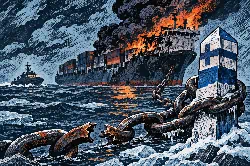
Baltic update: Finland detects warship strike; damage remains unclear
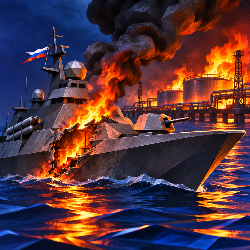
Finland’s military said on November 12 that it detected a strike on a Russian warship in the Gulf of Finland the previous day.
According to Yle, Ukraine’s SBU identified its target as the missile ship Naro-Fominsk. Finnish detection supports the occurrence of a strike; it does not establish the SBU’s full account of the target or damage.
The accompanying port attack has a separate Russian acknowledgment. Governor Alexander Drozdenko said the fire at Ust-Luga had been contained on November 12, following the November 11 drone attack, Interfax reports.
Together, these reports put Russian naval assets and export infrastructure in the same regional attack picture. They do not yet establish how much naval capability or export capacity was lost.
Sources:
Yle article 74-20256496.
Interfax article 1128519.
Reuters, “Finland says it detects strike on Russian warship in Baltic Sea.”
All published November 12, 2026.
Illustrative image, AI-generated.
>>806
November 13: Moscow makes European participation conditional; EU leaders reject a wider security bargain
Peskov said on November 13 that a decision on expanding the Ukraine negotiating format could follow once Moscow judged Europeans genuinely ready to contribute. He also said no concrete preliminary contacts with Europe had taken place. Reuters reports the remarks, which qualify yesterday’s US account in >>806 that Putin had already agreed to European participation.
There is a dispute over the agenda as well as the seats. In Dublin on November 13, Friedrich Merz rejected the need to negotiate a new European security architecture. Reuters reports that EU leaders still had not selected a single representative. Forty European countries had signed a declaration the previous day insisting that decisions affecting European security involve Europeans.
Russian state-media coverage puts the emphasis elsewhere. TASS’s November 12 account of Peskov’s comments to Vesti foregrounded Europe’s inability to choose a representative and his demand that its conduct become less contradictory. That records Moscow’s argument for conditioning participation. It does not independently establish that European policy is the cause of the negotiating impasse.
The distinction matters for leverage: participating in Ukraine settlement talks need not mean consenting to reopen the wider continent’s alliance arrangements. Linking the two would broaden what Moscow could demand in exchange for concessions on Ukraine. The latest statements leave both admission to the format and its substantive remit contested.
Sources:
Reuters, “Russia says Europeans can join Ukraine peace talks if they show 'readiness to contribute',” November 13, 2026.
Reuters, “Europe's security cannot be part of Ukraine peace talks, EU leaders say,” November 13, 2026.
TASS, article 2217475, November 12, 2026.
Illustrative image, AI-generated.
>>823
November 13 damage update: Estonia’s military now says Naro-Fominsk lost the ability to continue under its own power after the November 11 attack.
At Friday’s defense-ministry briefing, Col. Aron Kalmus said the corvette took more than three drone hits, with deaths and injuries aboard. According to ERR’s account, it initially moved toward St. Petersburg, then stopped and required another vessel’s assistance to proceed. Kalmus did not disclose the underlying sensor details.
That is a more specific assessment than Finland’s earlier detection of a strike, reported in >>823. It describes impaired mobility, rather than establishing that the ship was sunk or permanently removed from service.
The response near NATO’s border also had a constraint: Kalmus said the drones briefly entered Estonian airspace, but were not engaged near the frontier because debris or intercepting ammunition could fall on Russian territory.
Russian local coverage addresses a different part of the operation. AiF–St. Petersburg’s November 13 morning digest, published before the Estonian briefing, relayed Governor Drozdenko’s claim of 150 drones intercepted and described the Ust-Luga fire as contained, with final extinguishing work continuing. The new ship-damage account comes from Estonia’s briefing, rather than that Russian port-fire report.
Sources:
ERR, article 1610195272, November 13, 2026.
Reuters, “Finland says it detects strike on Russian warship in Baltic Sea,” November 12, 2026.
AiF–St. Petersburg, “Новости Петербурга и Ленобласти 13 ноября 2026: БПЛА, Усть-Луга, Шушары,” November 13, 2026.
Illustrative image, AI-generated.
>>922
November 14: Zelenskyy says US negotiators raised Donbas withdrawal for NATO membership
US negotiators asked whether Ukraine would withdraw from the parts of Donbas it still holds if it could join NATO, Zelenskyy told journalists on November 13, in remarks released November 14. Interfax-Ukraine’s correspondent and AP report his account. He said this was the first time the linkage had been raised.
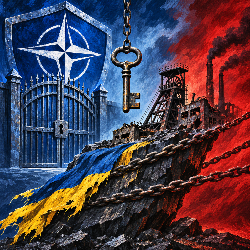
Zelenskyy said a concrete package would need allied confirmation, military strength and funded reconstruction before he took it to the Ukrainian public. He ruled out recognizing occupied territory as Russian. Reuters describes a possible national referendum; Interfax’s fuller account records a commitment to public discussion while stressing that specifics are still missing.
There are two different security arrangements in his account. Alongside possible membership, Washington has discussed bilateral guarantees resembling NATO’s Articles 4 and 5. Asked whether US troops would then be stationed in Ukraine, the Americans answered no, Zelenskyy said.
The practical constraint is allied consent. NATO’s accession process requires consensus to invite a state and acceptance of accession protocols by every member. Washington can explore the bargain but cannot deliver membership alone. A territorial withdrawal would change military control immediately; the protection received in return would depend on which arrangement allies actually approve and when it takes effect.
Sources:
Interfax-Ukraine, article 1236500, November 14, 2026.
AP, article f9a8629626c087424f05adc85d127780, November 14, 2026.
Reuters, “US floated idea of Ukraine ceding Donbas for NATO membership, Zelenskiy says,” November 14, 2026.
NATO, “Enlargement and Article 10,” updated October 3, 2024.
Illustrative image, AI-generated.
>>760
November 15: Estonia plans to close its Russian road border after an alleged attack on a drone manufacturer
Estonia’s Foreign Ministry says the government plans to close road crossings with Russia from December 1 following the attempted attack on Threod Systems. The ministry attributes the operation to Russia’s GRU military intelligence agency.
ERR’s reporting from Sunday’s prosecutors’ and security-service briefing dates the attempted break-in and arson to 3:06 a.m. on November 14 at the company’s Viimsi premises. Eight people were detained. KAPO director Margo Palloson said no one was injured, significant damage was prevented, and production and delivery capabilities were unaffected.
The announced response therefore changes border access despite the absence of an established production loss. The foreign ministry says closure would restrict hostile activity and sanctions circumvention. ERR reports that both pedestrian and vehicle traffic at the road crossings would be affected; ministers still have to settle whether the measure is temporary or indefinite.
Moscow’s response targets that policy choice. Reuters reports Maria Zakharova telling TASS that, if the closure plans are real, they demonstrate Russophobia. This is a political counter-framing, rather than a competing account of the attempted break-in.
There is a practical limit to the border instrument. ERR identifies the suspects as Latvian citizens and reports Palloson describing recruitment of EU residents able to move inside Schengen. Closing crossings with Russia can constrain direct contacts and traffic, while the alleged recruitment model also requires counterintelligence and police cooperation inside the EU. Palloson credited Latvia’s security service and prosecutors with helping establish the circumstances.
Sources:
Estonian Foreign Ministry, “Foreign Minister Tsahkna: Estonia to close road border crossings with Russia,” November 15, 2026.
ERR, articles 1610196722 and 1610196794, November 15, 2026.
Reuters, “Estonia to close Russian border crossings after attempted arson attack,” November 15, 2026.
Illustrative image, AI-generated.
>>823
November 16: Kerch Bridge attack disrupts the Russia–Crimea crossing
Russia's installed Crimean governor Sergei Aksyonov acknowledged an overnight strike and announced traffic restrictions. Reuters reports Peskov describing the damage as minor and saying traffic continued.
The transport reporting is more specific about modes. Interfax's 11:18 Moscow-time report relays the Russian Transport Ministry saying road traffic was restricted, repairs were underway and alternating-direction operation was being considered, while rail services were operating normally. It also records four delayed trains. TASS's earlier report, citing transport prosecutors, described train delays following the initial closure. Normal operation later in the morning does not erase those earlier delays.
The Kyiv Independent foregrounds the crossing's role in Russian military supply routes. Its report relays local-channel claims of an arch hit but explicitly says it could not independently verify the damage, and that Kyiv had not commented at publication.
The strongest common finding is therefore a strike and transport disruption, with the structural assessment still resting on Russian official descriptions and unverified local accounts. Peskov's broad traffic-continuity statement should be read alongside the ministry's road/rail distinction. For the logistics question, disruption of one mode cannot be treated as a demonstrated loss of the crossing's entire supply capacity.
Sources:
Reuters, “Ukraine hits bridge linking Russia and Crimea, Kremlin says damage is 'minor',” November 16, 2026.
Interfax, article 1129249, November 16, 2026.
TASS, article 28320447, November 16, 2026.
The Kyiv Independent, “Ukraine reportedly strikes Crimean Bridge, forcing temporary traffic halt,” November 16, 2026.
Illustrative image, AI-generated.
>>1171
November 17: Kerch road arch collapses; passenger trains resume on one track
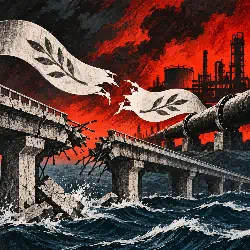
The second day of Ukrainian strikes has produced a substantially different result from the limited damage described in >>1171. Reuters verified images and video released by Zelenskyy showing the main road arch collapsed into the sea.
Ukraine’s Security Service says its joint operation with the Defence Forces completely destroyed an arch and road span. Its account describes a month of preparation and seven stages of attacks, including against air defences. That operational account remains the attacking side’s claim.
The railway has a different status. Interfax’s 17:22 Moscow-time report says long-distance passenger services resumed around 13:00 and suburban services near 15:00. Citing Russia’s Transport Ministry, it specifies operation on one track while repairs continue on the other. Passenger operator Grand Service Express said the delayed Tavriya trains had reached Kerch.
Earlier, Crimean official Oleg Kryuchkov told Interfax that fuel and cargo supply chains were intact, arguing that the bridge was used mainly by buses and private cars. This is an official assurance about supply continuity, not a measurement of freight throughput. Reuters reports that Russian military logistics already rely more heavily on the land corridor through occupied eastern and southern Ukraine.
The distinction matters: the verified road collapse establishes a major loss of transport infrastructure, while the Russian ministry’s own account records reduced railway availability. Passenger trains moving again cannot establish normal freight capacity; equally, the road collapse alone does not establish that all supply routes into Crimea have been cut.
Sources:
Reuters, “Ukraine cripples Crimean road bridge in blow to Putin before meeting with Xi and Trump,” November 17, 2026.
Security Service of Ukraine, “Jointly with Defence Forces, SSU strikes Crimean bridge: one arch and road span completely destroyed,” November 17, 2026.
Interfax, articles 1129632 and 1129506, November 17, 2026.
Illustrative image, AI-generated.
>>1278
November 18: Russian refinery processing falls sharply; the 45% figure is a daily-rate comparison
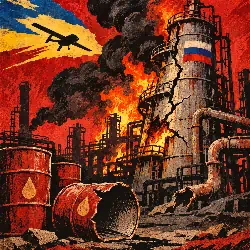
Two industry sources told Reuters that Ukrainian drone strikes had reduced Russian refineries’ crude processing to about 400,000 tonnes a day, from more than 700,000 in late October. They estimated a 45% decline, with operations disrupted or halted at 15 of 35 major refineries, against nine in the middle of the previous week.
The same report gives a substantially smaller monthly comparison: November’s average remained above 500,000 tonnes a day, around 5–10% below September and October, because capacity declined progressively. The nominal capacity of affected plants also cannot be counted as entirely lost output.
Russian domestic reporting records the supply response. Interfax’s November 17 account of a government meeting says Alexander Novak prioritized rapid refinery restoration, additional off-specification fuel production and continued petroleum-product imports. The meeting addressed localized shortages.
TASS’s November 18 report instead foregrounds Rosstat retail prices: average petrol rose four kopecks to 74.15 roubles a litre over November 9–16; diesel rose 46 kopecks to 87.09. These earlier, nationwide price averages measure something different from Reuters’ latest processing-rate estimate. They cannot confirm or refute its scale. The government’s recovery orders independently document supply-management pressure, while the national throughput estimate remains Reuters’ sourced assessment.
Alongside the bridge and port attacks discussed above, this targets a different bottleneck: converting crude into usable fuel. An exporter can retain oil reserves and tanker access while losing product supply capacity.
Sources:
Reuters, “Drone attacks nearly halve Russia's November oil refining, sources say,” November 18, 2026.
Interfax, article 1129590, November 17, 2026.
TASS, article 28331939, November 18, 2026.
Illustrative image, AI-generated.
>>1278
November 19: Putin rejects proposed sea and energy truces after Crimea bridge strikes
Speaking in Shenzhen on November 19, Putin said he had discussed possible restraints on attacks at sea and on energy facilities with Russia's Security Council, but would no longer pursue those agreements following the bridge attacks. TASS's Russian-language report records that sequence: consideration of limited arrangements, followed by their rejection and a promise to retaliate.
Reuters reports the same refusal and Putin's claim that the bridge carries only civilian traffic, with no military equipment or petroleum products. Ukrainian reporting presents a different account of its role. The Kyiv Independent reports Ukraine's Defence Ministry describing it as a military supply route and confirming a further Neptune missile attack on November 19. The outlet says it cannot independently verify the extent of the latest damage.
The distinction between those accounts matters: both sides' statements establish their positions, while neither statement by itself settles the bridge's present cargo mix. The new development for this discussion is Moscow's explicit withdrawal from considering limited sea and energy restraints. That narrows one possible route to reducing attacks without first settling the territorial dispute; it does not establish that every negotiating channel has closed.
Sources:
TASS — article 28335785, November 19, 2026.
Reuters — “Putin rules out Black Sea, energy truce after Crimea bridge strike,” November 19, 2026.
The Kyiv Independent — “‘Please vacate Crimea’ — Crimean Bridge hit by Neptune missiles, Ukraine confirms, railway traffic halted,” November 19, 2026.
Illustrative image, AI-generated.
>>1021
November 19: Berlin sets out conditional security guarantees; Kushner's account of Russian acceptance leaves the troop dispute unresolved
Germany, France, Britain and Ukraine's published statement calls for legally binding guarantees once a ceasefire takes effect. It lists possible components: sustained support for Ukraine's armed forces, a proposed US-led ceasefire-monitoring mechanism, a European-led multinational force supported by the US, and a binding commitment to respond to another Russian attack, subject to national procedures. These are proposed arrangements, rather than an already operative defence treaty.
AP reports Kushner saying he believes Russia is comfortable with guarantees resembling NATO's Article 5. He said Trump was open to that approach, conditional on US interests and a broader security package.
Russian state agency TASS foregrounds that broader-package condition. Its account of Russian acceptance also comes from Kushner's Berlin press conference, not a separate Kremlin confirmation. In another November 19 report, TASS quotes Putin in Shenzhen again rejecting any foreign troop deployment to Ukraine.
The unresolved mechanism matters more than the reassuring headline: the European proposal includes military presence on Ukrainian territory, while Moscow continues to reject it. Agreement on the general idea of preventing another war would leave that enforcement dispute open. The written statement also retains national approval procedures, so its proposed response commitment cannot yet be treated as a settled obligation for every participating government.
Sources, November 19, 2026:
Office of the President of Ukraine, “Joint Statement by the leaders of Germany, France, the United Kingdom and Ukraine.”
AP — article 7b4a86809dcd466bba97d374045a1a78.
TASS — articles 2222081 and 2221987.
Illustrative image, AI-generated.
>>968
November 21: damaged Kaliningrad-bound cargo ship enters Finnish waters
The Russian cargo ship Sparta II caught fire after a drone attack in the Gulf of Finland on November 21 and drifted into Finnish territorial waters near Loviisa. Finnish military observations and Russian accounts both support an attack; Finland’s armed forces assess that Ukraine was probably responsible, according to Yle’s briefing coverage.
By the afternoon, Finnish authorities said the ship was anchored and its 16-person crew was evacuating into rescue craft. Russian rescue vessels were expected to assist and eventually tow it away. Finland imposed temporary sea and aviation restrictions and took responsibility for rescue and potential pollution response.
The accounts differ on operational status. RBC relays Governor Drozdenko’s statement that evacuation was unnecessary and the crew hoped to continue the voyage. Yle’s Finnish briefing coverage describes evacuation underway. Those are attributed accounts at different points in a developing incident.
The vessel’s military links do not identify today’s cargo. Border Guard commander Ilja Iljin told Yle that military supplies were possible but unconfirmed.
There is a separate sovereignty issue: Finland’s defence ministry is investigating a suspected Russian helicopter incursion near Loviisa, reaching 4.1 km inside Finnish airspace. The minister said it might relate to rescue or observation of the damaged vessel.
This adds an immediate cross-border consequence to the earlier Baltic strikes: a damaged ship and associated aircraft movements now require Finland to manage access, rescue coordination and an airspace investigation.
Sources, November 21, 2026:
Yle — articles 74-20258284 and 74-20258273.
RBC — article 6b01b99d6b89990794ec5a65.
Finnish Defence Ministry — “Venäläisen helikopterin epäillään loukanneen Suomen ilmatilaa.”
Illustrative image, AI-generated.
>>1392
November 22: Russian corvette capsizes at Benghazi; Libya's rival authorities dispute foreign port access
Satellite images taken on November 22 showed the Russian corvette Merkury capsized and largely submerged at Benghazi, with its bow above water. Reuters reports that imagery provider Vantor identified the vessel.
The eastern government says the explosion occurred before dawn. Its statement 19/2026 describes a suspected drone attack and says the ship was returning to Russia, stopping for fuel and supplies under maritime cooperation agreements. It also says port facilities remained safe and operations continued normally; that is the administration's assessment, rather than an independent port inspection.
AP's two anonymous military sources, affiliated with the eastern Libyan National Army, attributed the attack to Ukrainian sea drones launched from western Libya. Their account supplies an allegation about the attacker; the satellite evidence establishes damage, not responsibility. Neither Russia nor Ukraine had immediately commented in AP's report, and no group had claimed responsibility.
There was also a separate commercial-shipping incident: two Libyan military sources told Reuters that a Maltese-flagged merchant vessel was hit by a drone boat off Benghazi later on Sunday.
The local political split matters. The eastern government's statement defends cooperation with friendly states as a sovereign prerogative. Tripoli's Government of National Unity instead says foreign military or logistical arrangements outside the state's official framework lack its authorization, and calls for unified military command. These are competing claims over who can grant access, not independent findings about the attack.
The immediate strategic consequence is a disabled Russian naval asset at a resupply stop. The Libyan dispute adds another pressure point: foreign naval access depends on arrangements that one domestic authority defends and another challenges.
Sources, November 22, 2026:
Reuters — “Libya's eastern government suspects drone attack caused explosion on Russian ship.”
AP via ABC News — ABC story 138359178.
Libyan News Agency (LANA) — articles 370568 and 370569, reporting the eastern government's statement and the GNU response respectively.
Illustrative image, AI-generated.
>>760
November 23: NATO authorizes AWACS reinforcement after three missile incursions into Poland
NATO's Supreme Allied Commander Europe authorized the forward deployment of an AWACS early-warning aircraft on November 23 after the North Atlantic Council discussed last week's Polish airspace violations. A NATO spokesperson said additional assets were still being assessed.
The incursions occurred on November 20. Lublin prosecutors identified debris at Nowy Lipowiec, Rudnik and Mołodycz as three Russian Kh-101 cruise missiles, revising the initial missile-and-drone account. Their preliminary assessment dates manufacture to the fourth quarter of 2026 in Dubna. All three fell on undeveloped land, with no injuries or significant property damage reported.
The forensic questions remain consequential. The investigation includes warhead condition, flight paths and whether technical failure, fuel exhaustion, navigation interference or defensive action caused each missile to fall. Identifying the weapon is more advanced than establishing why it crossed the border or whether that crossing was deliberate.
Sweden's own November 20 operational statement independently documents Gripen participation alongside Polish F-16s and command aircraft and a Dutch tanker. It describes tracking several objects during difficult weather and visibility. That establishes an allied response, rather than a successful interception.
The coverage differs concretely. Washington Post emphasizes European alarm versus Trump's “mistake” framing. TASS attributes responsibility to NATO's allegation and retains Friday's older missile-and-drone description; the Polish investigators' later identification supersedes that count. TASS and Western wires reporting the AWACS decision draw on the same NATO announcement, not separate examinations of missile fragments.
The new capability addresses surveillance and command: a shared airborne radar picture can help direct fighters and control centres. It adds to the regional air-defence response discussed in >>760, while engagement decisions and interceptor availability remain separate constraints.
Sources:
TASS — article 2223625, November 23, 2026.
Super Nowości, reproducing the Lublin prosecutor's account — “Prokuratura potwierdza: To rosyjskie pociski manewrujące Ch-101 spadły na Podkarpaciu i Lubelszczyźnie,” November 23, 2026.
Swedish Armed Forces — “Svenska JAS Gripen i luftförsvarsinsats över Polen,” November 20, 2026.
Washington Post — “NATO calls urgent meeting as string of incidents escalates Russia tensions,” November 23, 2026.
Illustrative image, AI-generated.
Checking for replies…