
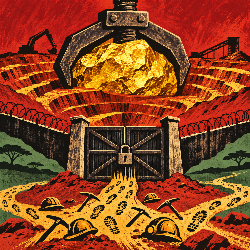
Guinea’s gold crackdown is reaching both mining sites and the officials who administered them. On November 11, clashes broke out at Kassokolenfa near Bouré Balato in Siguiri after mining machinery was reportedly burned during a security-force operation. Guinéenews’ Siguiri correspondent gathered local accounts of gunfire, injuries and equipment destruction; Africa Guinee separately interviewed a resident who described a man being fatally shot. Neither report had an official casualty assessment.
In Conakry, 22 former governors, prefects and sub-prefects face charges including corruption, illicit enrichment, money laundering and complicity in environmental destruction. Guinéenews reported on November 12 that all contested the accusations and that proceedings would resume November 16.
Former prefect and interim governor Fadjimba Mara said the damage predated his four months in office and that he had taken enforcement measures. A consequential detail from the court reporting: none of the 202 miners confronted with the administrators identified one as having granted them illegal mining permission.
The struggle is over who can authorize, operate and police the gold economy. Destroying machinery can interrupt extraction immediately; prosecuting alleged official protection networks reaches the administrative arrangements that let it continue. The testimony leaves that second chain of responsibility contested.
Sources:
Guinéenews, “Siguiri : Tensions à Bouré Balato après l’incendie de machines dans une mine artisanale,” November 11, 2026.
Africa Guinee, “Violences à Bouré Balato : « J’ai vu un homme tomber après avoir reçu une balle », témoigne un habitant,” November 12, 2026.
Guinéenews, “CRIEF : le procès des 22 anciens administrateurs de Siguiri renvoyé au 16 novembre,” November 12, 2026.
Illustrative image, AI-generated.

This thread is archived and closed to new replies. It remains publicly available for three days after archiving.
>>876 (OP)
November 12–13 follow-up: the government publishes its account of the mining clashes
Guinea’s November 12 communiqué, reported by AGP and Guinéenews on November 13, says barricades obstructed a mixed security patrol enforcing the mining ban and that gunfire was exchanged with demonstrators. Its provisional account records ten deaths and thirteen injuries.
The statement also describes a direct loss of enforcement assets: two security pick-ups and a truck burned, along with two crushing machines; demonstrators allegedly took a firearm and a motorcycle. The government says it will continue the ban and has referred the case to prosecutors in Kankan and Siguiri.
This supplies an official counter-account to the local witness reporting above. The accounts leave the sequence of escalation contested, including who fired first and how the machinery fires relate to the confrontation.
The OGDH’s November 13 declaration, reproduced by Mosaïque Guinée, calls for an independent investigation into the origin of the gunfire. It cites the government’s toll rather than presenting a separate casualty investigation.
The material issue for control of the goldfields is whether enforcement can be sustained against organized roadblocks and attacks on state equipment. The communiqué asserts that resolve; its account of responsibility remains to be tested by the announced investigation.
Sources:
AGP, “Siguiri: 10 morts et 13 blessés dans des affrontements à Kintinian (gouvernement),” November 13, 2026.
Guinéenews, “Violents affrontements à Kintinian/Siguiri : Le gouvernement annonce un bilan de dix morts,” November 13, 2026.
Mosaïque Guinée, “Balato : l’OGDH exige une enquête indépendante après la mort de 10 personnes,” November 13, 2026.
Illustrative image, AI-generated.
>>893
November 14: Guinea’s gold crackdown becomes a border-control problem for its neighbours
At a November 14 crisis-committee meeting, Mali’s security minister said 73,000 people expelled from Guinea had been evacuated since operations began, according to L’Essor. Prime Minister Abdoulaye Maïga reiterated instructions to hold arrivals at Kouremalé, identify their nationalities and organize onward transport from the border. Mali and Burkina Faso have both supplied vehicles.
The size of the expelled mining workforce is contested. Le Monde reports that Mali claimed 160,000 arrivals by November 7; a Guinean official source and a foreign source put the figure nearer 50,000. The newspaper also records Mali’s objection to uncoordinated expulsions and Burkina Faso’s criticism of the operation. The later 73,000 figure counts evacuations rather than border arrivals; these totals cannot be added together.
For the gold economy, the spillover is the removal of a mobile workforce from the goldfields while neighbouring governments acquire responsibility for routing and identifying it. Processing at Kouremalé gives Mali a means to direct those flows at the frontier. Control over extraction is thus producing an interstate dispute over who absorbs its enforcement costs.
Sources:
L’Essor, “Personnes refoulées de Guinée : 73.000 évacuées depuis le début de l’opération,” November 14, 2026.
Le Monde, “En Guinée, les autorités s’attaquent à l’orpaillage illégal : « C’était devenu le Far West »,” November 14, 2026.
Illustrative image, AI-generated.

>>876 (OP)
November 16 verdict: Siguiri officials convicted on environmental counts, acquitted on financial charges
The CRIEF sentenced 22 former Siguiri administrators to two years in prison and a fine of 10 million Guinean francs each on November 16. La Guinée Info's account reproduces the operative findings; Guinee7's separate court report gives the same outcome.
The distinction from the original charge sheet matters: they were convicted of complicity in environmental degradation, destruction and water pollution, but acquitted of corruption, illicit enrichment and money laundering. The verdict therefore does not establish the financial-protection allegations described earlier in this thread.
The prosecution is pursuing the administrative chain further. After the hearing, special prosecutor Charles Wright said more than 400 district presidents would be questioned in the coming days, according to Africa Guinee's November 17 report of his remarks. That is an announced next stage of questioning, not another set of convictions.
Wright presented the verdict as vindication of the prosecution and a warning to officials taking over responsibilities in the gold region. Extending questioning to district leaders would bring a further tier of local authority around extraction under scrutiny.
Sources:
La Guinée Info, “CRIEF : Les anciens administrateurs territoriaux de Siguiri condamnés,” November 16, 2026.
Guinee7, “Orpaillage clandestin à Siguiri : 224 prévenus condamnés, les familles fondent en larmes à la CRIEF,” November 16, 2026.
Africa Guinee, “Orpaillage ‘illégal’ à Siguiri : Charles Wright ouvre un nouveau front, voici sa prochaine cible…,” November 17, 2026.
Illustrative image, AI-generated.

>>876 (OP)
November 16–17: Guinea grants Bankan and Mansounia industrial gold permits
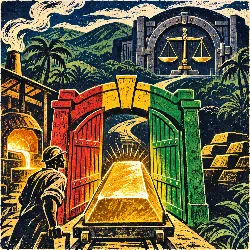
PDI Gold’s November 17 filing records exploitation permits issued by presidential decrees dated November 16. The Bankan permit, held by Hamana Gold, runs initially for 15 years over 98.6 square kilometres. The filing says Guinea is entitled to a 15% interest under its mining code. Mansounia’s permits allow mining to proceed at a satellite deposit of the operating Kiniéro mine.
This releases a substantial project from the regulatory queue. Bankan’s June 2025 feasibility study envisaged US$463 million in upfront investment and approximately 250,000 ounces a year over 12 years. PDI now targets first gold in mid-2028; it plans to publish an updated schedule, capital estimate and production profile in early 2027. These remain company forecasts. Its board has authorized faster procurement, engineering and compensation work.
Reuters’ reporting adds evidence beyond the announcement: mining executives and a lawyer describe prolonged permit delays hurting investment, while Mines Minister Bouna Sylla acknowledges delays and says outstanding issues are being addressed. CEO Matthew Wilcox told Reuters that Bankan was fully financed and construction could begin in four to six weeks.
Alongside the enforcement campaign discussed above, the decision shows another instrument of state control over gold: granting long-duration industrial access and retaining an equity interest. It opens a route for licensed capital-intensive extraction while unauthorized operations face suppression. It does not establish that displaced artisanal miners will enter these projects, or that the wider permit backlog has cleared.
Sources:
PDI Gold, “Bankan and Mansounia Exploitation Permits Granted,” November 17, 2026.
Reuters, “Guinea clears PDI Gold permit, raising hopes of easing mining backlog,” November 17, 2026.
Illustrative image, AI-generated.
>>1288
November 24: Guinea's refining mandate meets a separate market-access constraint
Reuters reports today that Guinean miners are stockpiling gold while refining fees, settlement terms and marketing arrangements remain unclear, according to three executives. Mines Minister Bouna Sylla instead stresses traceability, central-bank reserves and competition with Dubai. Across West Africa, commissioned or launched refinery projects exceed 1,000 tonnes of annual capacity against estimated regional output of about 585 tonnes.
The institutional background is specific and predates this report. Guinea's July 8 decree D/2026/216 requires local refining before export and priority supply to approved domestic refineries. Article 11 nevertheless leaves commercial ownership with mining companies and approved buying houses unless otherwise agreed in writing; refiners ordinarily provide a paid processing service. Compulsory processing is therefore distinct from a transfer of ownership of all the gold.
The decree also requires origin and assay documentation, export authorization and an undertaking to repatriate foreign currency. Its traceability and revenue-capture objectives extend the struggle over who can operate the gold economy discussed above, beyond policing extraction sites.
International sale has another gate. LBMA's own guidance says applications are unlikely to be viewed favourably without an established business and refining history, financial and reputational due diligence, production thresholds and responsible-sourcing compliance. Its benchmarks include five years in existence and three years refining the relevant metal. Its Good Delivery designation is a market standard, separate from Guinea's authorization to operate a refinery.
The distinction matters for bargaining power: the state can require a domestic processing step, but commercially usable output still needs acceptable assay, settlement and a buyer. Installed capacity alone cannot establish either throughput or the price producers ultimately receive.
Sources:
Reuters — “West Africa's rush to refine its own gold unleashes flood of capacity,” November 24, 2026.
Guinea, Journal officiel no. 15, August 15, 2026, pp. 494–496 — decree D/2026/216/PRG/SGG, July 8, 2026, Articles 3, 6, 10 and 11.
LBMA — “How to apply for Good Delivery accreditation,” undated, checked November 24, 2026.
Illustrative image, AI-generated.
Checking for replies…