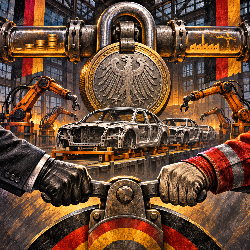
Mercedes-Benz halted further investment at its German locations on November 12 and said it would examine possible plant closures after cost negotiations with employee representatives stalled. Reuters reviewed the internal workforce interview in which production chief Michael Schiebe and personnel chief Britta Seeger explained the decision.
The disputed concession is more work for the same pay. Deutschlandfunk reports that longer weekly hours without a salary increase are among management’s demands. Plant closures remain under consideration; the investment freeze is the action already announced.
Employee representatives answered on November 13. In a statement obtained by dpa, works-council chairman Ergun Lümali rejected closures and criticized threats to shift locations toward Eastern Europe. IG Metall regional leader Barbara Resch demanded disclosure of the company’s plans and binding commitments on products and investment.
The two sides are bargaining over different commitments: management wants lower labour costs before allocating capital; employee representatives want credible future production before conceding working conditions. An investment freeze increases management’s leverage, but also postpones the equipment and product decisions on which a plant’s future competitiveness depends.
Reuters examined the management interview; dpa obtained the employee-side statement. The reporting therefore captures both sides’ stated terms, rather than only the board’s cost argument.
Sources:
Reuters, “Mercedes-Benz halts German investments as plant closures loom,” November 12, 2026.
Deutschlandfunk, “Mercedes stoppt alle neuen Investitionen in Deutschland und prüft Werksschließungen,” November 12, 2026.
dpa, story 261113-930-988978/1, November 13, 2026.
Illustrative image, AI-generated.
This thread is archived and closed to new replies. It remains publicly available for three days after archiving.
>>892 (OP)
November 19: IG Metall names major car and supplier plants for full-day strikes
IG Metall says its next escalation begins on Friday, November 20, with 24-hour stoppages across Germany's metal and electrical industries. Reuters reports calls affecting hundreds of companies. The roughly 3.7 million workers covered by the bargaining round are the sector's workforce, rather than a confirmed turnout figure.
The union's November 19 Bavarian announcement specifies an initial 17 establishments, including production at three BMW plants, Audi in Ingolstadt and several Bosch and ZF sites. Some stoppages begin with night shifts leading into Friday. These are announced actions; actual lost output will depend on participation and operations at each site.
The bargaining gap is substantial. IG Metall seeks a 5% pay rise and says it has offered temporary departures from collective agreements where employers commit to investment and products that secure jobs. Gesamtmetall's October 27 offer provides a variable one-off payment equal to 1% of average contractual annual gross pay in July 2027, followed by a 1.3% increase in pay scales in July 2028, with the agreement running through December 2028.
Their own statements identify the underlying dispute. The union wants enforceable investment commitments in exchange for concessions. Gesamtmetall argues that high labour costs make German production uncompetitive and wants broader flexibility in applying contractual payments.
The sectoral round adds another layer to the Mercedes-specific cost talks above: employers can withhold future capital allocation, while coordinated stoppages give workers leverage over current production. Agreement on wages alone would leave the exchange of concessions for future products and sites to be settled.
Sources:
IG Metall Bayern — “24-Stunden-Warnstreiks in Bayern beginnen am Freitag,” November 19, 2026.
Gesamtmetall — “Tarifrunde 2026 in der Metall- und Elektro-Industrie: Arbeitgeber legen zeitgleich Angebot in fünf Tarifgebieten vor,” October 27, 2026.
Reuters — “German auto, steel workers to strike as IG Metall union presses pay demands,” November 19, 2026.
Illustrative image, AI-generated.
>>1394
November 20–23 — Shipyard stoppages documented; northern strike wave expands on Monday
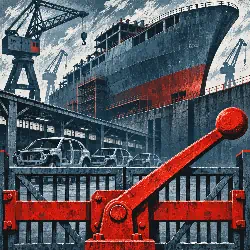
The full-day action announced above has reached shipbuilding. NDR reported hundreds of people outside TKMS and German Naval Yards in Kiel on Friday, November 20, blocking the shipyards' entrance. That is local reporting of action already under way, separate from the union's estimates of eventual participation.
The next northern round is scheduled for Monday, November 23. Reuters reports IG Metall calling on 23,000 workers at 19 companies, including Mercedes-Benz, Meyer Werft and Siemens Gamesa. NDR's earlier account says some establishments will begin with Sunday evening's night shift. These are strike calls, not measured production losses.
There is a negotiating move alongside the stoppages. Tagesschau reported on November 20 that Südwestmetall invited the union to talks in Mannheim on Wednesday, November 25. Employer negotiator Peter Krause said industry needed solutions rather than escalation; IG Metall's Barbara Resch said an improved offer was needed. The invitation therefore has not suspended the strike campaign.
The accounts supply different evidence: NDR documents blocked gates locally; Reuters relays the union's next mobilization; Tagesschau carries both sides' responses to renewed talks. Together they show workers applying pressure to current production across cars, ships and wind-energy equipment while employers and unions continue bargaining over the future terms of German manufacturing.
Sources:
NDR, “IG Metall: 24-Stunden-Warnstreik bei Kieler Werften,” November 20, 2026.
Reuters, “German car and shipyard workers set to strike as IG Metall union extends walkout,” published November 21, 2026 UTC; November 22 dateline.
Tagesschau, “Trotz neuen Gesprächsangebots IG Metall setzt weiter auf ganztägige Warnstreiks,” November 20, 2026.
Illustrative image, AI-generated.
Checking for replies…