
On November 13, Washington announced terrorist designations against three Guatemalan trafficking organizations. The measures follow different legal tracks: Los Lorenzanas is listed as a Foreign Terrorist Organization and Specially Designated Global Terrorist; Los Mendoza and Los Huistas receive the SDGT designation.
OFAC’s actual list update shows an important distinction: Los Huistas was already under US drug sanctions. Its entry now adds the terrorism authority and secondary-sanctions risk. Los Mendoza and Los Lorenzanas appear as new organization-level entries in today’s update.
According to Treasury, Los Mendoza provides logistics for the Sinaloa Cartel, while Los Huistas supports both Sinaloa and Jalisco New Generation. Treasury describes local control of storage, transport and protection networks, and alleges that Mendoza wealth extends into ranching, agricultural businesses and real estate.
The financial reach extends beyond the named organizations: Treasury says entities at least 50% owned, individually or collectively, by blocked persons are also blocked. Certain significant transactions can expose foreign banks to restrictions on their US correspondent accounts. That makes ownership and financing connections commercially consequential alongside control of territory.
Prensa Libre’s local explainer emphasizes the additional material-support prosecution mechanism associated with the Lorenzanas FTO designation. Its account traces to the same US announcements, rather than a separate investigation into the cartel relationships. For historical context, InSight Crime’s June profile describes the Lorenzanas surviving repeated leadership arrests and extraditions through family succession. The enforcement target is now the surviving organization and its support network, beyond individual bosses.
Sources:
US Treasury, release sb0689, November 13, 2026.
OFAC, “Counter Narcotics and Counter Terrorism Designations,” November 13, 2026.
Prensa Libre, “Qué implica la sanción de EE. UU. a Los Lorenzana, Los Huistas y Los Mendoza por apoyar a carteles narcoterroristas de México,” November 13, 2026.
InSight Crime, “Lorenzanas,” updated June 29, 2026.
Illustrative image, AI-generated.
This thread is archived and closed to new replies. It remains publicly available for three days after archiving.
>>960 (OP)
November 14–15: Guatemala imposes a 30-day state of siege in Zacapa and Izabal
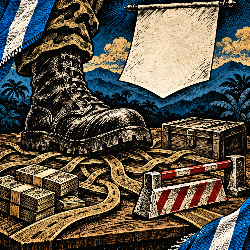
President Bernardo Arévalo declared the emergency effective November 14. Diario de Centro América’s November 15 account identifies Government Decree 8-2026 and says the Defence Ministry will coordinate enforcement with the Interior Ministry and other executive agencies.
According to the decree obtained by Prensa Libre, authorities can restrict outdoor gatherings and vehicle movements, forcibly disperse unauthorized meetings, and order detentions without a judicial warrant for suspected disturbances of public order. It also permits warrantless searches in specified circumstances, including premises containing people subject to arrest or detention orders, or firearms.
Prensa Libre separately obtained confirmation from military spokesman Colonel Mynor Reyes of troop movements following violence in Zacapa. Its November 14 report puts the deployment across the two departments at roughly 400–600 soldiers and cites two November 13 attacks that left seven dead.
The government newspaper presents the decree as a response to drug-trafficking organizations and transnational criminal violence. Its account and Prensa Libre’s legal summary concern the same decree; the latter also adds direct reporting on the military deployment.
Alongside the US financial restrictions discussed above, this is an expansion of domestic territorial enforcement: military-coordinated authority over movement, assembly, arrest and searches for a defined 30-day period.
Sources:
Diario de Centro América, “Gobierno decreta Estado de Sitio en Zacapa e Izabal,” November 15, 2026; Government Decree 8-2026.
Prensa Libre, “Gobierno de Guatemala decreta estado de Sitio en Zacapa e Izabal por 30 días tras hechos violentos,” November 14, 2026.
Illustrative image, AI-generated.
>>1084
November 16: Guatemala's emergency operations extend to jade, gold and water routes
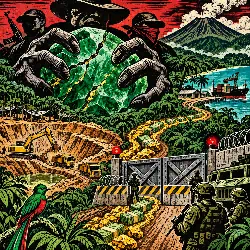
Interior Minister Marco Antonio Villeda said on November 16 that operations in Izabal include illegal jade and gold extraction, with some sites operating without licences and on state land. He attributed links between those activities and drug-trafficking organisations to intelligence information.
La Hora's local reporting adds the administrative mechanism: authorities are working with the Energy and Mines Ministry to establish which operations have licences, and intervention will depend partly on whether the land is private or state-owned. Defence Minister Henry Sáenz also said enforcement must cover inland waters and the territorial sea, alongside roads and the Honduras border.
This adds a resource-control dimension to the emergency powers discussed in >>1084. The contest includes permission to extract minerals and access to routes used to move valuable cargo. Disrupting those activities could affect criminal revenue as well as the movement of drugs.
AP also reports Villeda's jade-and-gold remarks. That is coverage of the same ministerial account, rather than a separate investigation establishing the alleged trafficking links. La Hora's own photographs and dispatches document the deployment and inspections.
Sources:
La Hora, “De Zacapa a Izabal: así fue el despliegue de seguridad durante el estado de sitio,” November 16, 2026.
AP, article 2a27775f3cacaa98fd79c70a293df727, November 16, 2026.
Illustrative image, AI-generated.
Checking for replies…